
Quick answer: The Standard Portland Classic matters because it combines history with present-day access. The tournament, underway August 13-16 at Columbia Edgewater Country Club, is billed by organizers as the LPGA's longest-running non-major and the Pacific Northwest's only professional tour stop. It gives tour players a $2 million stage, local fans a rare annual connection to elite golf and amateurs a direct look at the professional level.
Longevity is more than a trivia answer
Golf calendars change constantly. Sponsors rotate, venues move and events disappear when commercial support thins. Portland has endured through all of that. The tournament began in 1972 as the Portland Ladies Classic, according to the LPGA's official historical notes. It spent 1977 through 1982 as an unofficial team event, then continued evolving; in 2013 it expanded from the 54-hole format it had used for more than four decades to a standard 72-hole championship.
That history makes the tournament unusual, but age alone is not the point. A recurring event becomes part of a tour's infrastructure. Players know the travel rhythm. Volunteers build experience. Sponsors and charities have a stable local platform. Fans can connect one generation of champions to the next. Continuity turns a date on the schedule into an institution.
The organizer's description is precise: Portland is the longest-running non-major on the LPGA Tour. Majors carry their own protected status and mythology. A regular event has to keep earning its place. Portland's survival therefore says something important about the community around it, not just the names engraved on its history.
The Pacific Northwest needs a professional-golf anchor
The tournament website also calls the Portland Classic the Pacific Northwest's only professional tour stop. That claim gives this week a geographic importance that a normal schedule listing can hide. Large sections of the United States see elite touring golf only on television. Portland offers Oregon and the wider region a live point of contact: ropes, practice areas, course strategy, volunteers and the speed of professional competition at ground level.
That matters for young golfers in particular. Watching a broadcast can teach shot selection, but seeing the scale of the operation in person makes a professional pathway tangible. The event can turn an abstract ambition into something visible without requiring a family to travel across the country.
Regional scarcity also raises the cost of losing the tournament. If one event disappears in a golf-dense market, another may still be within driving distance. Portland does not have that cushion. Its annual week carries more responsibility because there is no nearby equivalent waiting to replace it.
Columbia Edgewater supplies a recognizable test
Columbia Edgewater Country Club is not merely a convenient host. The A.V. Macan design, founded in 1925, sits near the Columbia River and Portland International Airport. LPGA notes for the 2024 tournament said the club had hosted the event more than 30 times; that year's edition was the 34th at the course. The relationship gives Portland the kind of recurring competitive identity that moving tournaments rarely develop.
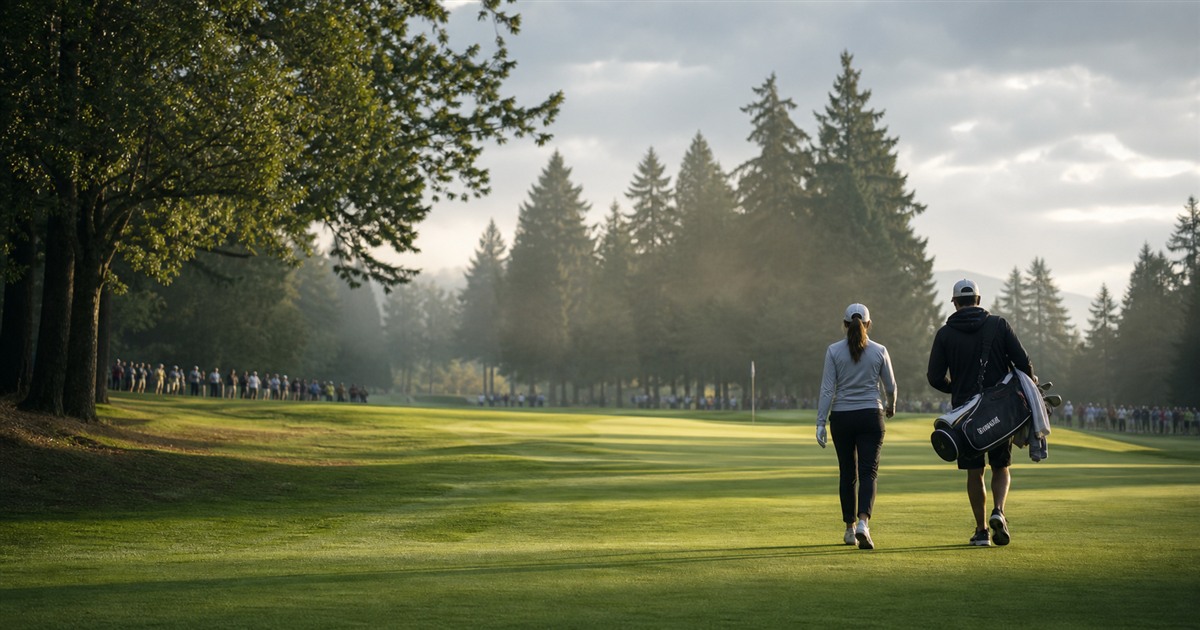
The course's tree-lined corridors and relatively compact greens reward placement and proximity rather than spectacle for its own sake. The LPGA's 2025 course fact sheet listed Columbia Edgewater at 6,497 yards, par 72, with average greens of about 5,500 square feet and 54 bunkers. Setup can change from year to year, but those figures explain the challenge: there is enough length to demand complete ball-striking, while the smaller targets increase the value of controlling approach shots.
Recent scoring shows that opportunity still exists. Akie Iwai won the 2025 event at 24 under par, four shots clear, after rounds of 67, 67, 64 and 66. Low scoring does not mean the course lacks teeth; it means a player must keep creating and converting chances because pars rarely separate the field.
The purse and points make it consequential now
History would ring hollow if the modern event did not matter competitively. The LPGA schedule lists a $2 million purse, and recent official tournament notes assign 500 Race to the CME Globe points to the winner. Those are real season-shaping rewards for a full-field event in the second half of the calendar.
The winner's platform matters too. Iwai's 2025 victory was her first on the LPGA Tour. She finished at 24 under, played her final 34 holes without a bogey and made 26 birdies for the week, according to the LPGA's final-round notes. Portland did not simply add another trophy to an established resume. It introduced a new tour winner.
That is one of the tournament's recurring strengths. Regular LPGA events create space for breakthroughs that majors, with their added pressure and qualification structures, cannot provide alone. A deep tour needs both: championships that define careers and weekly stages where careers can change direction.
Amateur access extends the event's value
The LPGA announced in March that four amateur exemptions would be offered in connection with the 2026 Portland Classic. Even without predicting what any invite will become, the structure is meaningful. An exemption provides more than a ceremonial tee time. It exposes a player to tour-course preparation, professional pacing, media obligations and the reality of making a 36-hole cut.
Portland's own amateur open reinforces that bridge. The tournament organizer has published a list of past amateur champions that includes players who later competed professionally. The important idea is not that every exemption must produce a star. It is that a durable tour event can serve the entire golf ecosystem around it, from spectators and volunteers to elite amateurs testing their games against professionals.
This is where longevity compounds. A one-off exhibition can inspire. A tournament that returns year after year can build a pathway, establish partnerships and give the next player a target on the calendar.
What to watch as the 2026 event unfolds
The 2026 championship runs through Sunday, August 16. The leaderboard will determine this year's story, but the best way to watch is through the course's demands. Notice which players repeatedly find the correct side of the fairway, control distance into the smaller greens and generate enough birdie chances to keep pace. At a venue where winning totals can plunge, avoiding mistakes is only half the job; sustained aggression with the right misses is the separator.
Also watch the crowd and the local texture around the competition. Those details are not background decoration. They are evidence of why the event has lasted. Professional golf is healthiest when its map is broad, its communities recognize their tournaments and its stages offer more than one route into relevance.
Portland's place on the LPGA schedule should not be taken for granted simply because it has been there for decades. Its history, regional role, competitive rewards and amateur access all answer the same question. The Portland Classic still matters because it connects the tour's past to the players and fans who will carry it forward.