
Quick answer: Scottie Scheffler is the clear player to beat at the BMW Championship after winning the FedEx St. Jude Championship by eight shots and extending his FedExCup lead to 4,123 points. Matt Fitzpatrick, Cameron Young, Collin Morikawa and Sam Burns lead the most credible group of challengers, but Bellerive's 7,448-yard test rewards the same complete tee-to-green game that just separated Scheffler from everyone in Memphis.
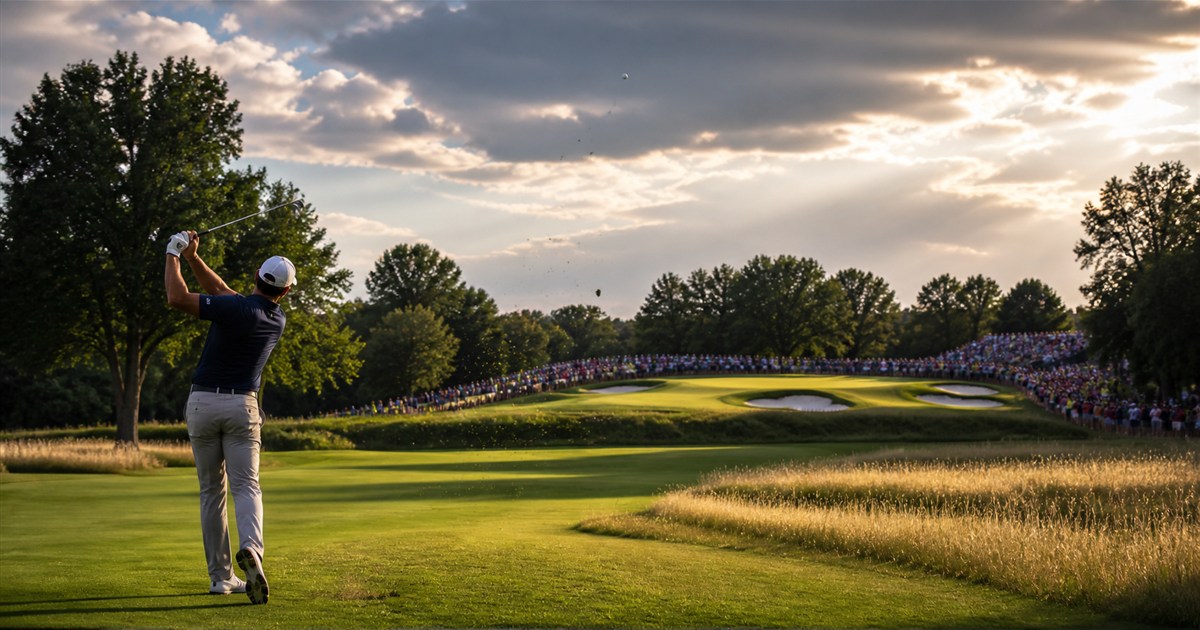
The BMW Championship begins Thursday with the most familiar question in men's golf suddenly carrying fresh urgency: is anybody equipped to stop Scottie Scheffler right now?
A week ago, that question still allowed room for debate. Scheffler had been the season's most consistent player, but his 2026 win total had not matched the historic pace of his previous two years. Then he shot 61 on Friday at TPC Southwind, built control of the tournament and eventually won the FedEx St. Jude Championship by eight strokes at 17-under.
That was not a narrow escape or a hot-putting theft. It was the kind of separation that changes the next tournament before the first tee shot. Every player arriving at Bellerive knows the standard has risen. Merely playing well may not be enough if Scheffler carries the same iron control and scoring patience into St. Louis.
Why Scheffler begins as more than the default favorite
The official FedExCup standings list Scheffler first with 4,123 points. Matt Fitzpatrick is second with 3,329, followed by Cameron Young at 3,086. The gap gives Scheffler security in the season race, but it does not reduce the value of this week: the BMW offers a $20 million purse, 750 points to the champion and only 30 places in the Tour Championship.
Scheffler also arrives as the defending BMW champion. That title came at Caves Valley in 2025, not Bellerive, so it provides no direct course advantage. What carries over is his comfort in the event's structure. There is no 36-hole cut. The top 50 play all four rounds, and a bad Thursday can be repaired without a Friday survival calculation.
That format may help the chasers, but it also helps Scheffler. His game produces fewer disastrous stretches than almost anyone else's. Four guaranteed rounds increase the chance that elite ball-striking eventually overwhelms a temporary putting deficit or a slow opening nine.
The interesting contrast is how quickly the season's concern has reversed. PGA Tour analysis in July noted that Scheffler's approach play had slipped from its almost untouchable 2025 standard, even while he remained the world No. 1, led the FedExCup and owned the Tour's lowest scoring average. Memphis supplied the response: when the irons and putter align, the field is again playing for second unless somebody creates an exceptional week.
Bellerive offers chances, but it does not offer hiding places
The PGA Tour's tournament media page lists Bellerive at 7,448 yards. Length alone does not define a course, but it makes weak driving harder to disguise. Players who repeatedly approach from rough or from too far back will place stress on every other part of the bag.
Bellerive's most recent men's major showed that the course can produce aggressive scoring without becoming easy. Brooks Koepka won the 2018 PGA Championship at 16-under, two ahead of Tiger Woods, who closed with a 64. Adam Scott finished third at 13-under. The leaderboard rewarded power, approach control and the nerve to keep making birdies while huge galleries pressed against the action.
The BMW setup is listed as a par 70, meaning the 7,448 yards will feel even more concentrated. The likely winning formula is not simply bombing driver. It is creating enough fairway position to attack long par 4s, converting the shorter opportunities and avoiding the rough-side misses that turn pars into scrambling exercises.
That sounds uncomfortably close to Scheffler's ideal. His advantage is rarely one spectacular category in isolation. It is the absence of a weak link. If Bellerive asks the field to drive, hit long irons, control trajectory, recover and hole enough putts over four days, the test becomes cumulative—and cumulative tests usually favor the most complete player.
Official PGA Championship highlights show the scoring opportunities and pressure Bellerive produced in 2018.
The four challengers with the clearest path
Matt Fitzpatrick starts second in the FedExCup and has three victories this season. His route is precision. If Bellerive rewards disciplined placement more than raw carry, Fitzpatrick has the control and competitive form to keep Scheffler from building an early cushion. The challenge is sustaining enough birdie volume if the course softens.
Cameron Young begins third after a season that included wins at The Players Championship and the Cadillac Championship. His ceiling is exactly what a Scheffler challenge requires: speed, high-end approach play and the ability to turn a demanding layout into a run of short birdie chances. Volatility is the tradeoff, but beating the favorite may require embracing more risk than usual.
Collin Morikawa, seventh in the standings, offers the purest iron-play counter. Bellerive's longer approaches could let him create separation from players who depend more heavily on wedge proximity. His question is conversion. Matching Scheffler from tee to green only matters if enough ten-to-20-foot chances disappear.
Sam Burns is eighth after playing in the final pairing with Scheffler in Memphis. Burns saw the pace directly. His putting can create the kind of scoring burst that changes a leaderboard quickly, and his familiarity with Scheffler removes any mystery. But he will need four rounds of controlled ball-striking, not merely one hot afternoon with the putter.
Wyndham Clark, Chris Gotterup, Si Woo Kim, Tommy Fleetwood and Ludvig Åberg all occupy the top ten and belong in the wider contender group. The reason to focus on four is not that the others cannot win. It is that defeating this version of Scheffler requires a visible mechanism: precision, power, elite irons or a genuinely decisive putting advantage.
The other drama is happening around 30th
Scheffler can think about winning. Much of the field has to think about Atlanta.
The BMW Championship is the second compression point of the playoffs. Seventy players became 50 after Memphis; 50 become 30 after Bellerive. The top 30 advance to the Tour Championship at East Lake, where the FedExCup is decided.
That creates two tournaments on the same course. Near the lead, players chase a trophy and 750 points. Near the projected cutoff, every shot can decide a season. A golfer in the high 20s may face a Sunday choice between attacking a difficult flag for position or protecting the par that keeps him inside the number.
The no-cut format sharpens that tension. Nobody disappears on Friday night. A player who opens poorly still gets the weekend to make a charge, and the projected line can swing with every birdie from the middle of the leaderboard. For viewers, that is the best argument against treating the event as a four-day coronation for Scheffler.
The pick—and what would prove it wrong
Scheffler is the pick because the evidence has converged: current form, season-long scoring, the FedExCup lead, a defending BMW title and a course that demands complete ball-striking. Picking anyone else requires betting that the Memphis performance will cool immediately or that a challenger will produce his best week of the year.
There are ways the pick can fail. Bellerive could become soft enough to turn the championship into a putting contest, reducing Scheffler's tee-to-green advantage. Morikawa or Young could gain multiple strokes per round with approaches. Burns could produce a career putting week. Fitzpatrick could make almost no strategic mistakes while forcing Scheffler to press.
Weather and setup will matter too. Firm greens elevate precise trajectory control; heavy rain gives longer hitters more freedom. The opening round will reveal whether Bellerive is asking for survival, patient accumulation or sustained aggression.
But the burden of proof belongs to the field. Scheffler just turned a playoff opener into an eight-shot statement. At Bellerive, 49 players have four rounds to show that statement was one great week rather than the start of another runaway August.