Quick answer: Wyndham Clark won the 2026 BMW Championship at 17-under 263. He closed with an even-par 70 at Bellerive Country Club and birdied Nos. 16, 17 and 18 to beat Patrick Cantlay by three strokes. Rory McIlroy finished third, four back. The victory was Clark's sixth on the PGA Tour and third of 2026.
A five-shot lead became a three-hole finish
Clark began Sunday at 17-under, five shots clear of McIlroy and Cantlay. The advantage looked large enough to make the closing round a question of control. Instead, Bellerive turned it into a test of recovery. Clark gave away ground early, failed to make a birdie through 15 holes and allowed McIlroy to draw level on the back nine.
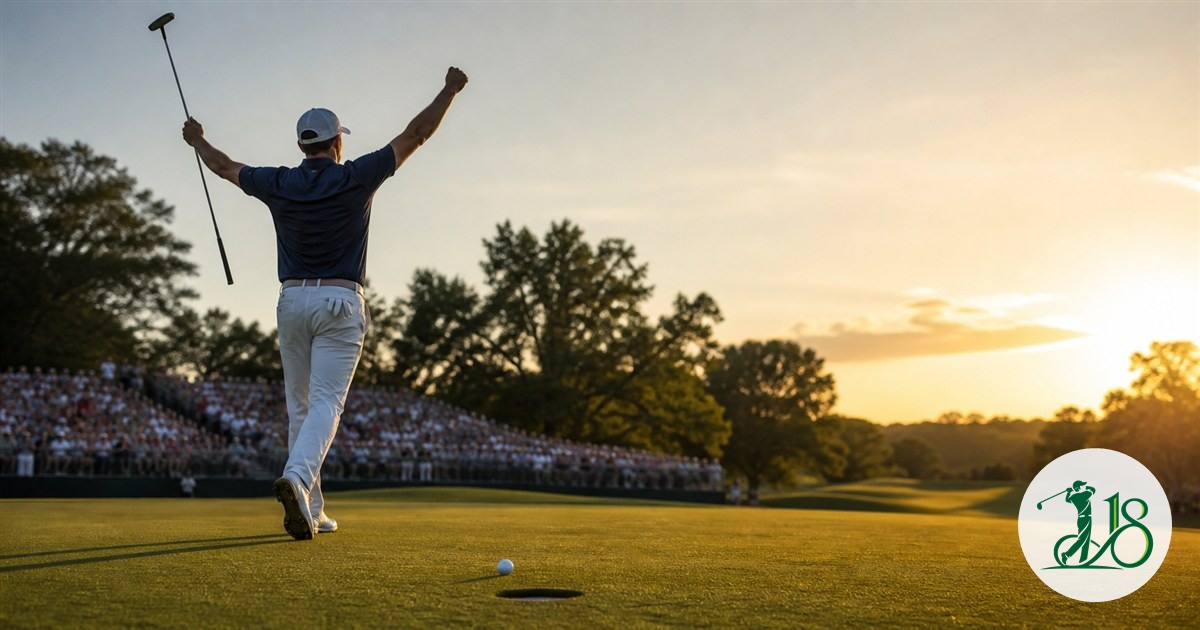
What happened next defined the championship. Clark rolled in a 16-and-a-half-foot birdie putt on the par-3 16th to retake the lead. He followed it with a 13-footer at the 17th after an approach from 145 yards, then closed with a 17-foot birdie at the 18th. His only three birdies of the day arrived on the final three holes. A round that had spent most of the afternoon threatening to become a collapse ended with the most decisive finish in the field.
The official leaderboard lists Clark's rounds as 64, 64, 65 and 70 for 263. Cantlay's closing 68 moved him to 14-under 266 and solo second. McIlroy shot 69 for third at 13-under, while Gary Woodland, Collin Morikawa and Chris Gotterup shared fourth at 12-under. Clark did not preserve the five-shot margin he carried to the first tee, but he produced the shots that mattered when the margin vanished.
The winning skill was emotional reset
A leader who loses a large cushion faces a different problem from a player charging from behind. The swing is not only numerical. Every mistake feels like evidence that the day is slipping away, and every roar elsewhere increases the temptation to force the next shot. Clark's final stretch worked because he did not need to recover all five lost strokes. He needed to reset the contest from the moment McIlroy caught him.
The birdie at 16 changed the emotional balance immediately. A par would have kept Clark tied and required him to survive two more holes. The made putt restored a lead and put pressure back on McIlroy. At 17, McIlroy made bogey while Clark made birdie, creating a two-shot swing that turned a level match into separation. The last birdie was not necessary to avoid a playoff, but it gave the final result its three-shot margin.
That sequence explains why an even-par 70 can still be a champion's round. Clark's score was six strokes worse than his first-round total and five worse than Saturday's 65. It was also exactly good enough because he produced three high-value putts after 15 holes without one. Tournament golf rewards the placement of scoring as much as the volume.
McIlroy made the lead disappear
McIlroy began five behind and needed to make the final pairing feel like a direct match. He did. After opening rounds of 64, 69 and 65, his closing 69 brought him to 13-under. For a stretch on the back nine, the deficit was gone and the pressure belonged entirely to Clark.
The decisive difference was the 17th. McIlroy's bogey arrived as Clark created a birdie chance from the fairway. Instead of leaving the tournament tied or separated by one, the hole produced a two-shot swing. McIlroy's challenge had succeeded in forcing Clark to answer; Clark's answer was better.
Cantlay played the steadiest closing round among the top three. His 68 completed scores of 67, 65, 66 and 68. Starting five behind from the penultimate pairing, he climbed past McIlroy and secured second, but Clark's final birdie run kept even that polished round three strokes short.
Friday and Saturday built the room for Sunday
The result cannot be understood only through the final three holes. Clark won because he arrived on Sunday with room to endure a difficult afternoon. Consecutive 64s opened the week, and Saturday's 65 took him to 17-under. His 193 total through 54 holes tied the BMW Championship's three-round scoring record.
That work mattered when the final round became uncomfortable. A player starting one ahead could not have survived 15 birdie-free holes. Clark's five-shot cushion gave him time to locate his game, even as the leaderboard tightened. The lead was nearly consumed, but it did not disappear early enough for the chasers to establish control.
The week therefore combined two different ways to win. For three days Clark overwhelmed Bellerive with scoring. On Sunday he absorbed pressure and finished with precision. The final total stayed at 17-under from Saturday night to Sunday evening, yet the meaning of that number changed completely. It went from a dominant lead to a tested winning score.
What the victory means
The BMW title is Clark's sixth PGA Tour victory and his third of 2026. He had already won the CJ CUP Byron Nelson with a closing 60 and captured his second U.S. Open at Shinnecock Hills. Adding a FedExCup Playoffs event gives his season range: a low-scoring shootout, a major-championship survival test and a playoff win built from both dominance and recovery.
The PGA Tour's pre-tournament facts listed a $20 million purse, a $3.6 million winner's share and 750 FedExCup points for first place. The BMW Championship is also the gateway to the 30-player Tour Championship. Clark entered the week safely inside the top 30, so his title was not about survival. It was about carrying another victory and stronger positioning into East Lake.
The venue adds context. Bellerive played as a par 70 at 7,448 yards, and the BMW returned to the St. Louis course for the first time since Camilo Villegas won there in 2008. Clark's 17-under total matched the winning score Viktor Hovland posted in 2023, although the courses and conditions were different. More important than the historical comparison was the immediate one: nobody else in the 50-player playoff field matched Clark across four rounds.
The morning forecast got the winner right
Infinite18's Sunday-morning forecast picked Clark because of his five-shot lead, record-tying 193, three consecutive rounds of 65 or better and history converting 54-hole leads. The choice was correct. The forecast also identified McIlroy and Cantlay as the two strongest threats, and they finished third and second.
What the forecast underestimated was how completely Clark's advantage would disappear. It argued that a clean opening six holes would allow him to manage the afternoon. Clark did not get the low-stress path. McIlroy tied him, Cantlay passed McIlroy, and the result remained uncertain deep into the back nine.
That distinction matters. The prediction was right about the winner and the relevant challengers, but wrong about the shape of the close. Clark won not because the five-shot lead made Sunday routine. He won because, once the lead was gone, he produced birdies on every remaining hole.
Three putts transformed the story
Through 15 holes, Clark's final round could have been remembered as a squandered advantage. Three holes later, it became a demonstration of closing nerve. That is not hindsight decoration; the official highlight titles identify the 16th-hole birdie, the 145-yard approach at 17 and the 17-foot putt at 18 as the shots that sealed the win.
The most useful lesson is that control is not always continuous. Clark controlled the tournament for three days, lost control on Sunday and then reclaimed it. His response did not require a swing rebuild or a miraculous recovery from trouble. It required committing to three ordinary tournament shots and converting three demanding putts.
Bellerive delivered the pressure that a five-shot lead appeared to remove. McIlroy supplied the charge, Cantlay supplied the clean closing card, and Clark supplied the finish. At 17-under, he leaves St. Louis with the BMW Championship, a third victory of the season and one of the sharpest closing sequences of the 2026 PGA Tour year.