
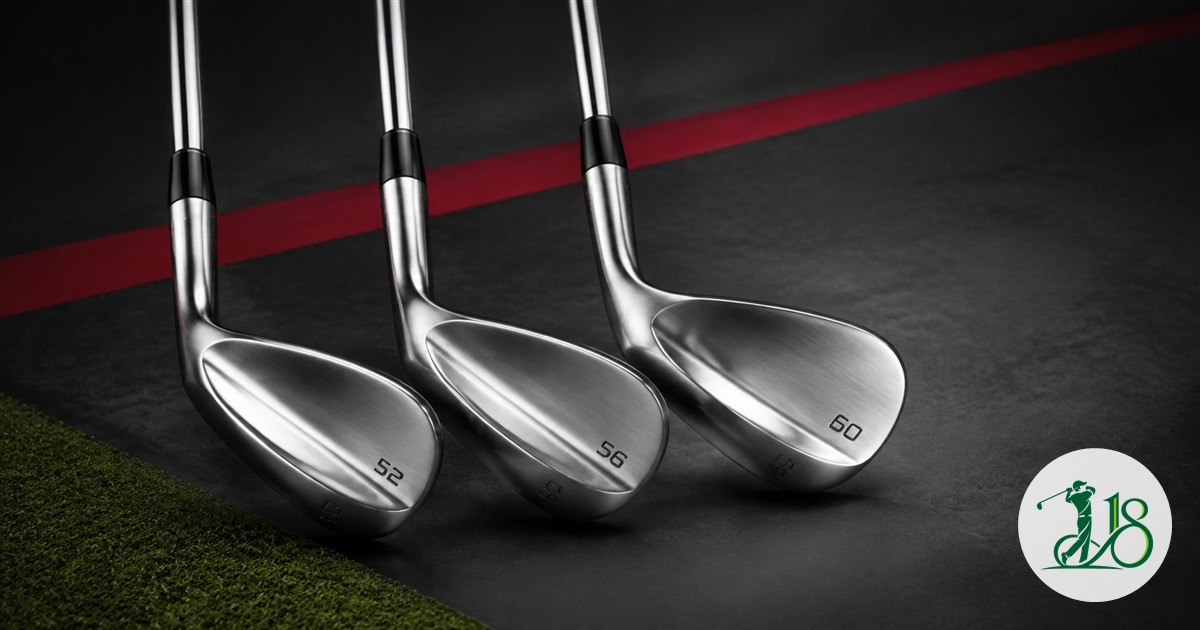
Quick answer: The Kirkland Signature Gen 3 Forged set costs $199.99 for 52-, 56- and 60-degree wedges. Costco says the clubs use forged mild carbon-steel heads, sandblasted faces, progressive centers of gravity, Lamkin Crossline 360 grips and Kirkland wedge-flex shafts. MyGolfSpy ranked the set first overall in its 2026 Most Wanted Wedge test after it placed second in accuracy, spin and consistency.
The most disruptive equipment release of 2026 may be sitting beside bulk paper towels. Costco's third-generation Kirkland wedges have taken the familiar warehouse-club proposition—acceptable performance at an absurd price—and pushed it into genuinely premium territory.
The headline is not just that three wedges cost roughly what one flagship wedge costs. It is that the new set performed well enough to win MyGolfSpy's 2026 wedge test. A value club can survive a few compromises. A test winner must deliver shots.
What changed in Gen 3
The previous Kirkland wedges were cast. Gen 3 moves to forged mild carbon steel, a construction associated with softer impact feel and the compact feedback better players want. Costco also replaced its earlier milled-face language with Sandblast Face Technology and says the finish is designed to increase spin and accuracy.
The set remains simple: 52 degrees for gap-wedge duty, 56 for sand shots and versatile pitches, and 60 for high, short shots. Each club uses a progressive center of gravity intended to produce appropriate launch and spin as loft increases. Lamkin Crossline 360 grips are recognizable aftermarket components, while the Kirkland wedge-flex shaft keeps the package standardized.
That specification is important because Costco did not reach $199.99 by selling stripped-down heads with toy-store grips. It chose familiar components, a forged construction and a useful loft progression, then eliminated the custom-fitting menu that adds complexity and cost elsewhere.
Why the test result matters
MyGolfSpy's result is striking because the Gen 3 did not win by dominating one narrow metric and hiding weaknesses elsewhere. It finished second in all three of the test's scoring categories: accuracy, spin and consistency. That balance pushed it to first overall with a 9.1 combined score.
The published data included 9,022 rpm of backspin, 90.5 percent straight performance and 2.32 yards of dispersion in the displayed comparison. Individual golfers will produce different numbers, but the relative result matters: the Kirkland was not merely spinning a lot while scattering shots. It paired stopping power with repeatable delivery.
Wet-condition performance may be the biggest surprise. Moisture between the face and ball can sharply reduce friction, creating launch-and-spin fliers. MyGolfSpy specifically highlighted the Kirkland's ability to perform in that test. For everyday golfers playing morning dew, damp rough and imperfect lies, that is more useful than a perfect range number.
The value math is almost unfair
At $199.99, each Kirkland costs about $66.67 before tax. A single premium wedge commonly approaches or exceeds $180. Building a three-wedge setup at that level can cost close to $600. Kirkland asks for roughly one-third of that amount.
That gap changes the buying decision. A golfer with worn grooves no longer has to stretch the life of three old wedges because replacement feels extravagant. A newer player can build sensible gapping instead of trying to manufacture every short-game shot with one sand wedge. A frequent player could replace grooves more regularly and still spend less across several seasons.
Price does not make a club good. It makes good performance more consequential. Gen 3 appears to deliver both.
Where Kirkland still compromises
There is only one loft package. Golfers whose pitching wedge is 46 degrees may love the six-degree gap to 52; players carrying a modern 43-degree pitching wedge could be left with a nine-degree hole. Those golfers may need a 48- or 50-degree option that Costco does not provide.
There is also no bounce-and-grind matrix. A steep player on soft turf and a shallow player on firm turf are asked to use the same sole. Premium wedge fitting exists because those differences affect contact, bunker performance and the ability to open the face.
The stock wedge-flex shaft may suit a broad middle of the market but not every delivery. Players who carefully match shaft weight and profile through their irons and wedges will not find that service here. Availability is another issue: the Gen 3 set sold quickly, and Costco inventory can appear and vanish without the predictable cycles of a traditional golf brand.
Finally, buying three clubs together only saves money if all three belong in the bag. Golfers who rarely use a 60-degree wedge may be better served by two individually fitted wedges, even at a higher price per club.
Who should buy them
The ideal Gen 3 customer is a golfer who wants a complete, conventional short-game setup without paying for customization he will not use. Mid-handicappers, newer golfers improving quickly, high-volume players wearing grooves and budget-conscious golfers are obvious fits.
Better players should not dismiss them. Forged feel and elite test performance make the Kirklands credible. The deciding question is fit, not status. If the lofts, shaft and sole match a player's delivery, there is no performance rule requiring a tour-brand badge.
Golfers should check the distance from their pitching wedge before buying, hit bunker and tight-lie shots during the return window, and judge trajectory rather than chasing spin alone. The 60-degree wedge should earn its place; it should not enter the bag just because it came in the box.
The verdict
The Kirkland Gen 3 wedges are amazing in the way that matters: they make premium short-game performance accessible. The forged heads improve the proposition, the stock build is credible and independent testing says the clubs deliver accuracy, spin and consistency rather than merely looking the part.
They are not infinitely adjustable and they cannot replace a skilled fitting for every golfer. But those caveats clarify the achievement. Costco built one configuration for a wide audience and made it competitive with clubs costing nearly three times as much per head.
For golfers whose gapping and turf conditions fit the package, Gen 3 is not just the best cheap wedge set. It is one of the best wedge buys in golf.