
Quick answer: The United States and Europe split Friday morning foursomes 2-2 at the 2026 Solheim Cup. Nelly Korda and Allisen Corpuz won 4 and 3 to become 5-0 as a Solheim Cup alternate-shot pairing, and Alison Lee and Lauren Coughlin added a 3-and-2 American win. Europe recovered through Maja Stark and Linn Grant, 3 and 2, before Esther Henseleit and Leona Maguire won 1 up.
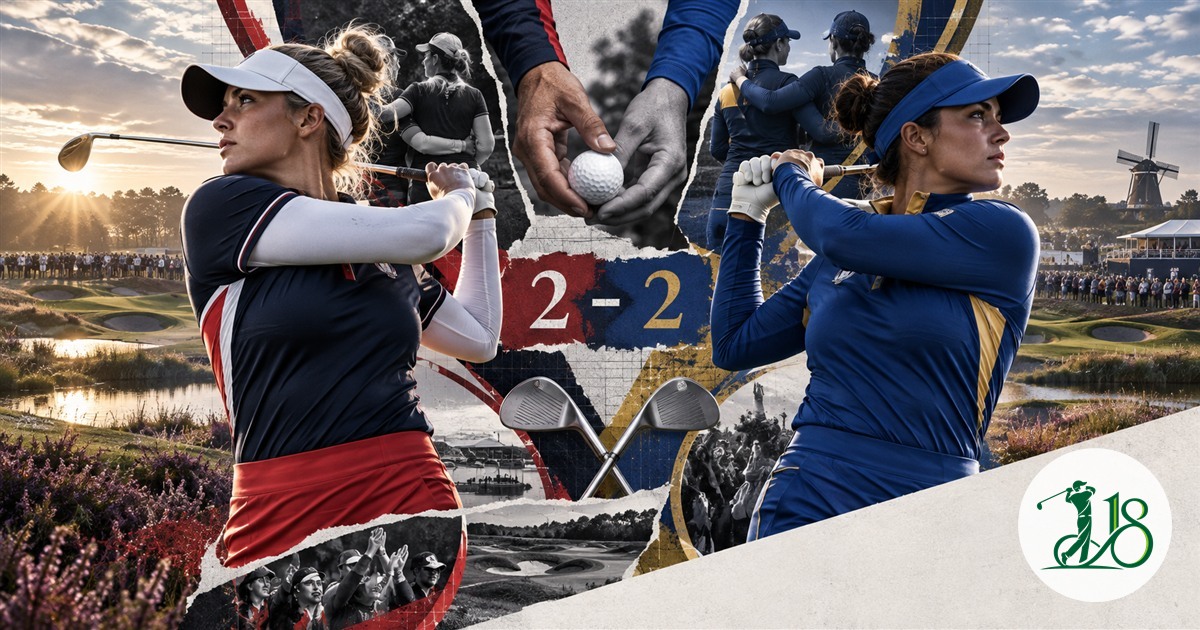
Friday morning at Bernardus began as an American statement and ended as a European escape. The United States won the first two foursomes matches, Europe controlled the third, and the final match reached the 18th green before the hosts secured the point that made the opening session level.
A 2-2 score after four matches does not settle much in a 28-point contest, but it revealed plenty. The Americans have a partnership that increasingly looks automatic. Europe has enough resilience to absorb a fast start. Both captains also received immediate evidence about which combinations can be trusted when alternate shot returns Saturday morning.
The United States, as defending champion, needs 14 points to retain the cup. Europe needs 14.5 to win it back. That half-point difference makes a tied opening session slightly more comfortable for Angela Stanford's team, but Anna Nordqvist will view the recovery as essential after the first two matches threatened to turn the morning red.
Korda and Corpuz have become the automatic first move
Korda and Corpuz defeated Charley Hull and rookie Lottie Woad 4 and 3. The margin was emphatic, but the larger number is five: five Solheim Cup foursomes matches together, five victories.
Stanford's decision to send them first required little invention. Before play she described Corpuz as the backbone of the American team and emphasized how naturally the pair complements each other. Korda supplies the world-number-one profile and overwhelming ceiling. Corpuz supplies controlled tempo, resilience and the kind of low-drama golf that alternate shot rewards.
The format magnifies incompatibility because each player must repeatedly inherit the position created by her partner. Korda and Corpuz appear comfortable with that responsibility. Their record now spans three Solheim Cups and has survived different courses, opponents and competitive circumstances.
The opening match also mattered because Europe countered with its most visible veteran and highest-ranked newcomer. Hull was making her eighth Solheim Cup appearance, while Woad entered as Europe's top-ranked player. Beating that pairing did more than produce one point; it neutralized an aggressive home-team opening and forced Europe to chase.
The United States found a second functional pairing
Alison Lee and Lauren Coughlin followed with a 3-and-2 victory over Celine Boutier and Nanna Koerstz Madsen. Unlike Korda and Corpuz, the American pair had no established Solheim record together. Their success gave Stanford something almost as valuable as the opening point: evidence that a new combination can handle the format.
Coughlin arrived with an unbeaten 3-0-1 record from her 2024 debut. Lee brought experience from previous cups. Together they kept the pressure on after Europe briefly moved ahead early in the match and converted an opponent's water mistake into momentum.
At that stage, a lopsided session was possible. A 3-1 American morning would have put Europe immediately behind the retention pace, while 4-0 would have transformed the entire event. The response in the final two matches therefore mattered more than a routine split suggests.
Stark and Grant restored Europe's identity
Maja Stark and Linn Grant defeated Rose Zhang and Jennifer Kupcho 3 and 2. They were Europe's only opening partnership with previous Solheim Cup experience together, and their familiarity showed.
The Swedish pair built a four-hole advantage by the turn, absorbed an American eagle at the 10th and a birdie at the 11th, then closed the match before it could become a full comeback. Grant's iron play and Stark's putting supplied the control Europe had lacked in the first two games.
For Nordqvist, the point validates more than friendship or national familiarity. Alternate shot is a sequencing exercise. Captains must decide who will hit from the odd and even tees, how those assignments interact with the par threes and which player's misses the partner is best equipped to rescue. Stark and Grant looked prepared for those shared decisions.
Europe's opening-session energy at Bernardus.
— Solheim Cup Team Europe (@SolheimCupEuro) September 11, 2026
Henseleit and Maguire delivered the point Europe had to have
The last match was the morning's pressure test. Esther Henseleit and Leona Maguire beat Andrea Lee and American rookie Lindy Duncan 1 up, taking the contest to the final hole after a back-and-forth round.
Maguire's approach at the 17th helped Europe seize the late advantage. That moment fit her Solheim reputation: she entered the week with 8.5 points from three appearances and has repeatedly turned ordinary-looking positions into difficult match-play problems.
Henseleit, in her second cup, gave the pairing enough stability for Maguire's instincts to matter. Their win changed the emotional shape of the scoreboard. Europe did not merely avoid a deficit; it showed its less obvious combinations could survive close matches after the United States' strongest pair had dominated.
What the 2-2 split means for the captains
Stanford leaves the morning knowing that Korda and Corpuz remain her safest foursomes point and that Coughlin can succeed with another partner. Nordqvist knows Stark and Grant should remain central to her alternate-shot planning and that Maguire's match-play value is still larger than ordinary stroke-play form can measure.
The captains must also manage workload. Every player competes in Sunday's singles, but four players from each side sit during each team session. Korda's importance creates a temptation to use her constantly. Europe's need for Hull's aggression, Woad's current quality and Maguire's match-play experience creates the same pressure.
A tie does not mean the teams performed identically. The United States won its two matches with room to spare; Europe needed one decisive result and one final-hole win. Match play, however, awards one point regardless of margin. A 4-and-3 victory and a 1-up victory carry equal scoreboard value. That is why Europe's closing point was so important.
Bernardus has already made precision the argument
The Dutch venue is hosting the Solheim Cup for the first time. Its exposed heathland character, shaped bunkers and risk-reward angles give foursomes teams repeated choices between position and aggression. In alternate shot, a bold line does not only belong to the player attempting it; the partner owns the next consequence.
The opening session rewarded combinations that controlled those handoffs. Korda and Corpuz kept building favorable positions. Stark and Grant did the same after establishing their lead. The closest match was decided by a late approach rather than a burst of individual scoring.
That pattern may not carry directly into fourballs, where both players complete each hole and the better score counts. Fourballs creates more freedom to attack because one partner can provide security while the other takes on risk. It also gives Europe an opportunity to use aggressive players differently after the controlled demands of the morning.
The first session produced a real contest, not a verdict
The United States owns the most dependable partnership in the competition. Europe owns the home crowd and proved it could answer before the scoreboard became dangerous. Both conclusions can be true.
The Americans should be encouraged by the quality of their first two wins. Europe should be encouraged that it reached level without a point from Hull and Woad. The next tactical question is whether Stanford can turn her top-end pairings into separation, or whether Nordqvist can keep finding enough depth to make every session a draw or better.
Friday morning did not identify a favorite. It clarified the fight. The United States has the partnership everyone expected to deliver. Europe has the resistance required to keep the Solheim Cup close. At 2-2, Bernardus has exactly what the opening day needed: pressure on every decision that follows.