
Quick answer: Shane Lowry shot an eight-under 62 in Friday's second round at Trump International Golf Links in Doonbeg, setting the course record and reaching 11 under for the Amgen Irish Open. His nine-birdie round created a three-shot halfway lead over Haotong Li, Jacob Skov Olesen and Niklas Norgaard.
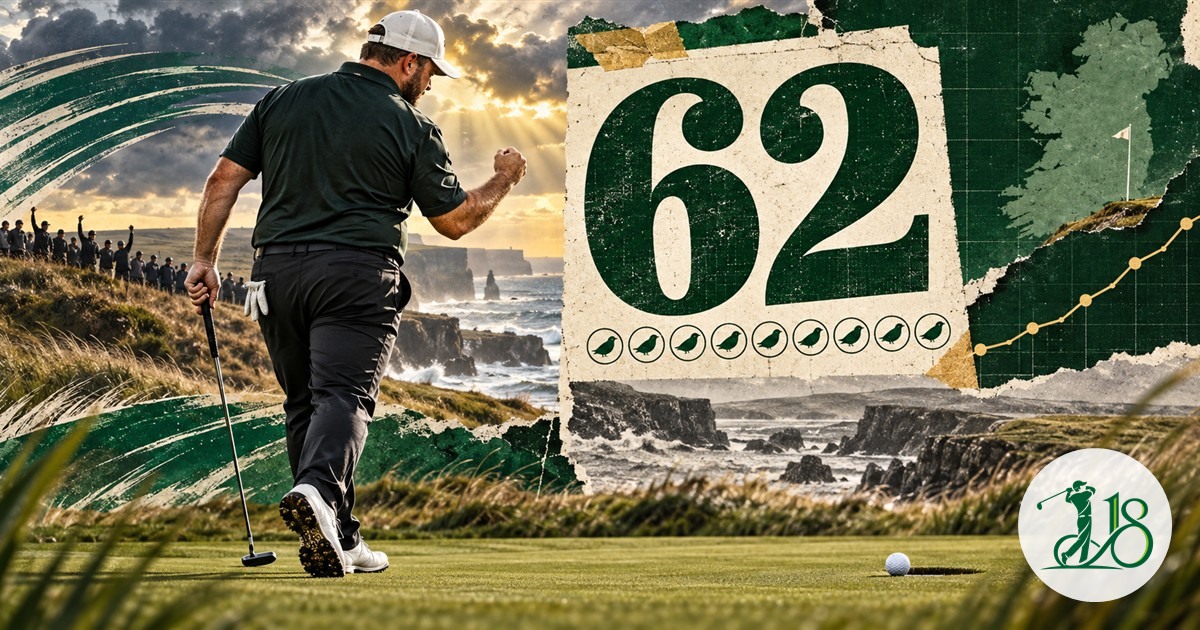
Shane Lowry arrived at the second round of the Irish Open three shots behind and left with the tournament organized around him. His course-record 62 was not simply the lowest number posted at Doonbeg this week. It was the kind of round that changes what everybody else must do.
Lowry made nine birdies against one bogey, reached 11 under and established a three-shot advantage at the halfway point. Haotong Li, Jacob Skov Olesen and Niklas Norgaard shared second at eight under. Tom McKibbin remained within range at seven under, while defending champion Rory McIlroy reached two under after a late eagle but faced a nine-shot weekend deficit.
The leaderboard says Lowry is in control. Links golf says control can disappear quickly. That tension makes Saturday's third round more interesting than the margin alone suggests.
A putting day finally matched the quality of Lowry's ball-striking
Lowry described the round as one of the most enjoyable he has played in some time, and the score explains why. He began aggressively, accumulated birdies across the front nine and reached a point where 59 entered the conversation. His only bogey came at the 13th after a three-putt, but he answered with another birdie at the 15th and closed with three pars.
The important difference was on the greens. Lowry's tee-to-green game has rarely been the mystery. His best weeks usually arrive when a reliable long game is paired with enough converted chances to turn good positions into visible separation. Friday was that formula at its highest level: opportunities arrived repeatedly, and the putter kept cashing them.
A 62 also carries personal context. Lowry matched the men's major-championship scoring record with the same number at Valhalla in the 2024 PGA Championship. The courses and competitive situations were different, but both rounds showed his ability to sustain scoring momentum rather than merely assemble a tidy card.
A course record and the halfway lead at Doonbeg.
— DP World Tour (@DPWorldTour) September 11, 2026
The three-shot margin forces the chasing group to choose
Li, Olesen and Norgaard begin the weekend close enough to apply pressure but far enough behind that passive golf may not work. Each reached eight under with a low second round, proving the course can yield birdies when the wind and greens cooperate. Their challenge is sustaining that pace while Lowry has the freedom to respond rather than initiate every attack.
That is the strategic advantage of a three-shot lead after 36 holes. Lowry does not need to chase the first risky flag on Saturday. He can watch how the course is playing, protect the holes where trouble is concentrated and force the contenders to reduce the deficit without gifting them an opening.
But the same margin can create defensive thinking. On a links layout, weather can reverse the value of a score within minutes. A player who begins protecting par before conditions demand it can surrender momentum to someone posting birdies from an earlier group. Lowry's strongest plan is likely the one Friday already validated: continue creating chances with controlled aggression and let the leaderboard react.
Doonbeg will not promise the same course twice
Thursday's opening round was slowed and complicated by wind, backups and difficult conditions. Friday produced record scoring. That contrast is the defining feature of the championship venue.
Doonbeg's exposed fairways, coastal movement and links contours reward imagination, but they also magnify small errors. A tee shot that uses a slope in one wind can run toward trouble when the direction changes. Approaches that finish near the hole on receptive greens can release beyond safe areas when the surface firms.
Lowry is well equipped for that uncertainty. His 2019 Open Championship victory at Royal Portrush remains the clearest evidence, but the more relevant point is how comfortable he appears choosing flight, trajectory and landing point rather than relying on a single stock shot. Those skills matter when the scorecard yardage describes only part of the problem.
The 2009 victory still gives this lead unusual weight
Lowry won the Irish Open as an amateur in 2009, defeating Robert Rock in a playoff and immediately changing the direction of his career. Seventeen years later, another home victory would carry a different meaning. It would connect the breakthrough version of Lowry to the major champion and veteran who now understands exactly what a national open asks of its leading player.
The home crowd can provide energy, but it also turns every miss into a collective reaction. Lowry will feel that attention more intensely than any other contender. Friday he used it. The weekend will test whether he can keep the atmosphere from accelerating his decisions when patience is required.
History adds another incentive. Consecutive Irish winners of the national open have been rare; RTE noted that the last back-to-back winners from the island came when Fred Daly and Harry Bradshaw won in 1946 and 1947. McIlroy won in 2025, so a Lowry victory would recreate that sequence nearly eight decades later.
McIlroy needs a charge, not just a solid weekend
McIlroy's second round never developed into Lowry's birdie run. A superb fairway-metal approach produced an eagle at the eighth and helped him reach two under, but nine shots is a substantial gap with 36 holes remaining.
That does not remove the defending champion from the story. His scoring ceiling is high enough to produce the kind of Saturday number that changes the final round. It does change the requirement: a pair of merely good rounds will not be enough if Lowry remains under par.
McKibbin, four shots behind at seven under, occupies a realistic stalking position. He can reach Sunday contention with one strong round without requiring Lowry to collapse. The group at eight under is closer still, and all three players have already shown they can score at Doonbeg.
Lowry is the clear favorite, but Saturday decides the shape of Sunday
A three-shot halfway lead does not guarantee a trophy. It does make Lowry the player with the fewest questions to answer. He owns the course record, has the best current score, knows how to win this championship and has a game suited to changing links conditions.
The first weekend test is not whether he can reproduce 62. Almost nobody should expect that. It is whether he can follow an exceptional round with a disciplined one, avoid giving multiple shots back in a short stretch and keep the chasers far enough away that Sunday begins on his terms.
Friday's 62 was the spectacular part. The next 36 holes are about conversion. Lowry has made the Irish Open his tournament to lose; now he must keep playing as if it is still there to win.