Quick answer: Shane Lowry shot a final-round 63 to win the 2026 Amgen Irish Open by 11 strokes over Patrick Reed and Joaquin Niemann. His 23-under total of 257 set the tournament's 72-hole scoring record, while the 11-shot margin was the largest in Irish Open history. It was Lowry's second Irish Open title, 17 years after he won as an amateur in 2009.
Shane Lowry began Sunday with the kind of advantage that invites caution. Four shots clear, playing in front of a home crowd and trying to end a long wait for an individual title, he could have treated par as his ally.
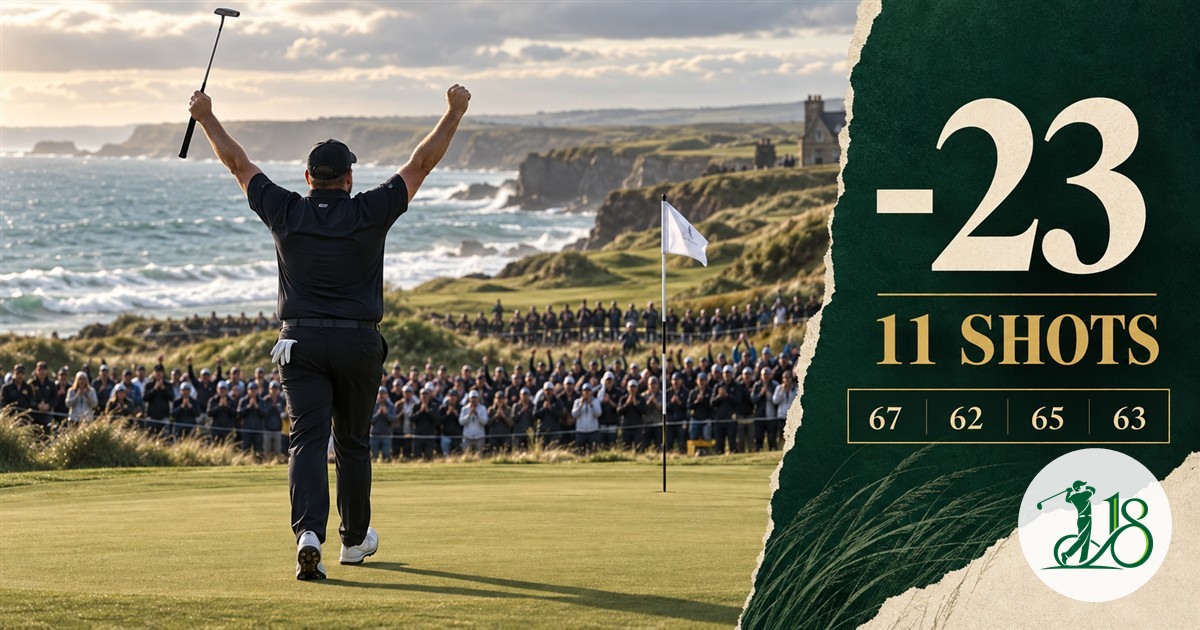
Instead, Lowry made the final round feel like an exhibition. He birdied the first hole, added three more over his opening eight and kept widening the distance until the Irish Open had no competitive suspense left. A closing 30-foot birdie at the 18th completed a seven-under 63, a 23-under total and an 11-shot victory over Patrick Reed and Joaquin Niemann.
The numbers require context because each broke something. Lowry's 257 was seven strokes lower than the previous Irish Open 72-hole total of 264 set by Jon Rahm at Lahinch in 2019. His margin was one better than the tournament's previous record. The four rounds—67, 62, 65 and 63—contained no score worse than three under par.
The final round was an argument against protecting a lead
Lowry's four-shot cushion could have disappeared quickly on an exposed links course. His playing partner Jacob Skov Olesen had already shown on Saturday that the lead could be challenged, catching Lowry around the turn before the Irishman pulled away again.
Sunday never developed that tension. Lowry's opening birdie settled him immediately. The 45-foot putt over a ridge at the seventh was the signature blow: a difficult read converted into another gain while the chasing group needed something extraordinary merely to stop the margin from growing.
Reed produced a 64 and Niemann a 67. Those are legitimate closing scores, yet both finished at 12 under—the same distance behind Lowry as a player shooting 74 would have finished behind a routine 63. The runners-up did not hand him the tournament. He removed it from them.
A course record and the halfway lead at Doonbeg.
— DP World Tour (@DPWorldTour) September 11, 2026
Friday's 62 changed what was possible
The tournament turned in the second round. Lowry began Friday three shots off the pace, then made nine birdies against one bogey for a course-record 62. That round moved him to 11 under and established a three-shot halfway lead.
It also revealed the formula he sustained all weekend. Doonbeg demanded control in the wind, but Lowry combined accurate iron play with confident putting. The course record was not an isolated hot streak surrounded by survival golf. He followed it with 65 and 63, playing the final 54 holes in 20 under.
That distinction explains the historic margin. A single spectacular round can create separation; two more elite rounds after it turn separation into domination. Lowry gained ground when conditions and pressure should have encouraged regression.
The victory closes a 17-year circle
Lowry's relationship with the Irish Open began with one of European golf's most unusual breakthroughs. In 2009, the 22-year-old amateur won at County Louth after a playoff, becoming only the third amateur to win a European Tour event. He turned professional shortly afterward, meaning he could not collect the winner's check, but the trophy launched his career.
Seventeen years later, the second title arrived with none of the uncertainty of the first. Lowry is now an Open champion, a World Golf Championships winner and a Ryder Cup veteran. At Doonbeg he played like the field's established standard, not its surprise.
The gap between the two wins also matters emotionally. Home opens carry expectations that ordinary tour events do not. Every missed opportunity is remembered, and every good round increases the volume around the next one. Lowry's tears after the final putt reflected more than the size of the victory. He had finally returned to the same trophy as a fully formed professional.
The 257 resets the Irish Open scoring benchmark
Comparing totals across courses is imperfect. Par, weather, setup and architecture change from year to year. Even so, tournament records mark how completely one player solved the test placed in front of him.
Rahm's 264 at Lahinch had stood as the lowest 72-hole aggregate. Lowry beat it by seven. He also finished at 23 under, two strokes lower relative to par than the long-standing 21-under mark associated with Christy O'Connor Jr.'s 1975 victory.
The record margin may be the more revealing achievement. Winning by 11 means Lowry was not simply better than one challenger; he separated from an entire field that included major champions, elite DP World Tour players and accomplished LIV golfers. Reed shot 64 and still lost ground.
What the win says before Wentworth
The BMW PGA Championship begins this week at Wentworth, where Lowry won in 2022. Form does not transfer automatically from exposed links to a parkland course, but the underlying signs travel well: controlled approach play, a hot putter and the confidence to keep attacking after taking command.
The victory also ends the distinction between team success and individual drought. Lowry won the 2024 Zurich Classic alongside Rory McIlroy, but his previous solo title had been the 2022 BMW PGA Championship. Doonbeg supplies a recent individual result that matches the quality of his play.
It strengthens his position in the DP World Tour's Back 9 and adds momentum before the season's closing stretch. More broadly, it reminds the golf world that Lowry's ceiling remains major-championship high when his iron play and putting align.
This was dominance, not merely a homecoming
The setting made the victory memorable: Irish galleries, an Atlantic links and the same national championship that introduced Lowry to professional golf. The performance made it historic.
He started the week with 67, broke the course record with 62, strengthened his lead with 65 and finished with 63. He birdied the last from 30 feet after the outcome had long been settled. He won by 11 because he continued playing to score rather than playing not to lose.
Lowry returned to the Irish Open winner's circle after 17 years. The record book will make the wait easy to remember: 23 under, 257 strokes, 11 clear.