Quick answer: The 2026 Presidents Cup opens Thursday with five four-ball matches at Medinah. Scottie Scheffler and Sam Burns lead off for the United States against Min Woo Lee and Sungjae Im, while Tom Kim and Si Woo Kim anchor the International Team against Chris Gotterup and Patrick Cantlay. Brandt Snedeker is playing three U.S. rookies immediately but sitting Russell Henley and Jacob Bridgeman; Geoff Ogilvy is holding out Christiaan Bezuidenhout and Nick Taylor.
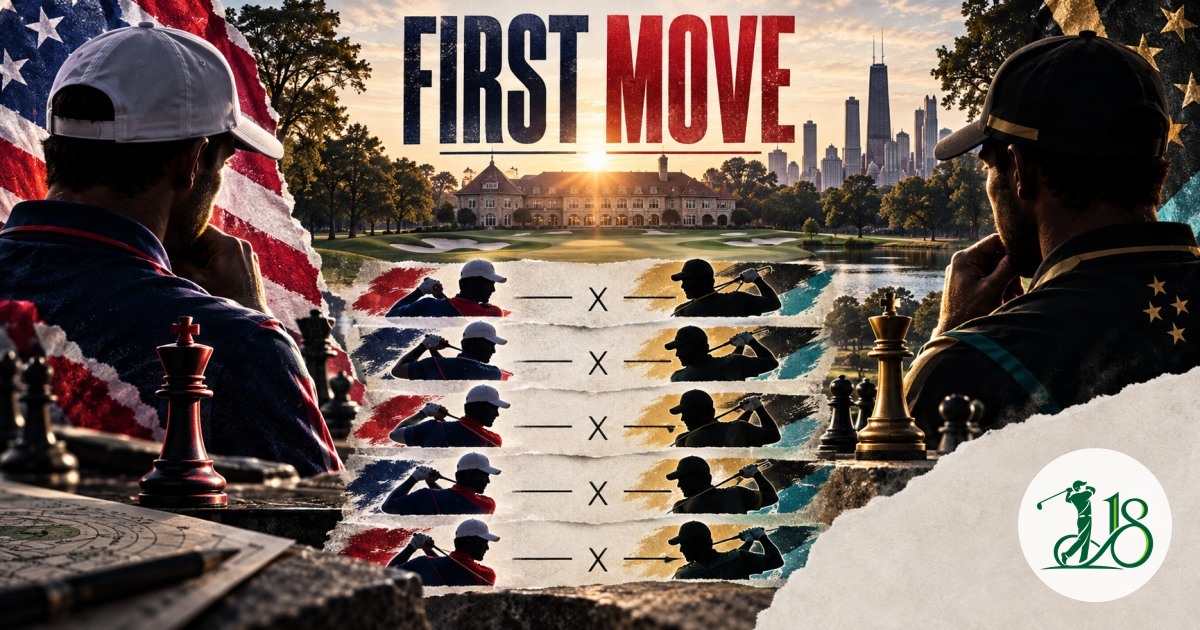
The first competitive decision of the Presidents Cup arrived before either team hit a shot. Brandt Snedeker and Geoff Ogilvy built Thursday's lineup one match at a time, revealing which partnerships they trust, which rookies they want exposed early and where each captain believes the opening session can turn.
Four-ball rewards aggressive scoring because both partners play their own ball and the lower score counts. It is the format most likely to free a debutant and the one least likely to punish a single poor swing. Snedeker used that freedom to place three rookies—Cameron Young, Jackson Koivun and Chris Gotterup—in the first wave. Ogilvy countered with combinations designed around energy, familiarity and experience.
The United States has led after the opening day in eight of the last nine Presidents Cups. Each time it did, it ultimately won. The exception was 2019, when the International Team led 4-1 before the Americans rallied. That history makes Thursday more than an introduction: the underdog cannot afford to let a deep U.S. roster establish control.
The complete Thursday four-ball slate
Match 1 begins at 11:35 a.m. CT: Scottie Scheffler and Sam Burns face Min Woo Lee and Sungjae Im. Match 2 follows at 11:53, with Cameron Young and Xander Schauffele against Hideki Matsuyama and Ryo Hisatsune. At 12:11 p.m., Justin Thomas and Jackson Koivun meet Corey Conners and Nico Echavarria.
Match 4 starts at 12:29: Wyndham Clark and Collin Morikawa oppose Ryan Fox and Adam Scott. The anchor match at 12:47 sends Chris Gotterup and Patrick Cantlay against Tom Kim and Si Woo Kim.
Those five matches put ten players from each side into action. Russell Henley and Jacob Bridgeman sit for the United States; Christiaan Bezuidenhout and Nick Taylor sit for the Internationals. Every player must appear at least once before Sunday singles, so the four rested players remain part of the immediate plan rather than being buried on the bench.
Scheffler and Burns get the responsibility, not a soft landing
Sending the world's top player first is a statement, but pairing Scheffler with Burns is not automatic security. The friends are an intuitive personality match, yet their Presidents Cup and Ryder Cup partnership record is 0-3-1. Their task is to convert comfort into a result that their previous team appearances did not deliver.
Lee and Im are built to disrupt that opening. Lee brings visible emotion and birdie-making volatility; Im brings repetition and calm. Ogilvy chose them knowing the first tee would carry the largest surge of opening-day noise. If they can absorb it and win holes early, the International Team can quiet the home crowd before the rest of the session settles.
The matchup therefore tests two different kinds of familiarity. Scheffler and Burns know each other deeply but need proof on the scorecard. Lee and Im carry a shared Korean connection but must establish a competitive rhythm in this particular event. The winner may give a psychological signal larger than one point.
The official PGA Tour selection special established the 12-player teams the captains are now deploying at Medinah. Video: PGA Tour on YouTube.
Snedeker separates proven partners to guide rookies
The most revealing U.S. choice is what did not happen: Schauffele and Cantlay are not together. Their established partnership is one of the easiest combinations for an American captain to write down. Instead, Snedeker spread their experience across the lineup.
Schauffele plays with Young, whose power and birdie potential fit four-ball. Cantlay gets Gotterup in the anchor match, a position that places the rookie inside the loudest International pairing. Thomas, an emotional team player with 11 points from 15 prior Presidents Cup matches, shepherds 21-year-old Koivun.
This is a depth strategy. Rather than stack two or three familiar pairs and leave rookies together, Snedeker has assigned a veteran stabilizer to each newcomer. It increases the chance that every match has someone comfortable with the pace and theater of team golf. It also sacrifices the certainty of the Schauffele-Cantlay partnership for a broader session-wide floor.
Koivun's placement is especially bold. He has climbed rapidly but enters his first senior U.S. team event. Thomas can handle the communication burden and create emotional oxygen after a mistake. Against Conners and Echavarria, the Americans face precise ball-striking rather than the most intimidating personalities on the International roster. That gives the rookie a demanding but manageable introduction.
Ogilvy saves his most combustible pair for last
Tom Kim and Si Woo Kim produced some of the International Team's most memorable energy in 2024. Ogilvy placed them in the fifth match, where their emotion can either chase an American lead or extend International momentum. It is also the matchup most likely to feel like a road-game pressure test for Gotterup.
Cantlay is an ideal stabilizer for that environment. His restrained pace contrasts with the Kims' outward energy, and his 10-4-0 Presidents Cup record supplies credibility. Gotterup does not have to match every celebration; he has to keep creating birdie chances while Cantlay controls the emotional temperature.
The Internationals also distribute their major champions. Matsuyama partners Hisatsune against Young and Schauffele. Scott plays his record-tying 12th Presidents Cup beside reigning Open champion Ryan Fox. Those combinations place experience next to players capable of making birdies in clusters, which is the correct four-ball profile.
The fourth match may be the session's hinge
Clark and Morikawa against Fox and Scott lacks the obvious theater of the lead and anchor matches, but it may be the cleanest measure of the teams. Clark can overpower sections of Medinah. Morikawa supplies elite approach control and owns a 6-2-0 Presidents Cup record. Their skills complement each other without requiring a long partnership history.
Fox and Scott offer a similar contrast. Fox brings current major-champion confidence and enough speed to attack. Scott brings a lifetime of Presidents Cup experience and the urgency of a player still seeking his first team victory in the event. If the International side wins that middle-late point, it reduces the burden on the Kims in the finale.
Medinah's renovated No. 3 course is set at par 70 and 7,548 yards. Four-ball should reward power, but the format is ultimately about overlapping strengths. A long hitter can attack while a steadier partner protects par; two accurate players can apply pressure by keeping both balls in every hole. Captains have paired for those roles, not simply by world ranking.
What to watch before the scoreboard fills
First, watch the American rookies on the opening three holes. Early birdies would validate Snedeker's decision to use them immediately. Early nerves could force their veteran partners to play conservatively, erasing the advantage of four-ball.
Second, watch whether Scheffler and Burns improve on their shared record. Their placement says Snedeker trusts the relationship despite the results. A win would settle the question quickly; another flat performance would make a Friday repeat difficult to justify.
Third, measure the International Team's emotional control. Ogilvy wants energy without volatility. Lee and the Kims can animate a session, but Medinah's home crowd will react to every swing. The underdogs need celebrations that build confidence rather than distractions that shorten focus.
The pairings are only a plan. By Thursday evening they will be evidence. Snedeker has chosen to spread experience and accelerate his rookies. Ogilvy has built a lineup that can absorb the opening roar and finish with its most expressive partnership. The first captain to see his theory become points will own the first move—and possibly the shape of the week.