
Quick answer: The USGA and R&A have opened manufacturer consultation on three possible Model Local Rules for elite competition: a golf-ball test capped at 317 yards without the current apparent three-yard tolerance, a driver characteristic-time target of 239 microseconds without the current 18-microsecond tolerance, and a maximum club length shorter than today's 46 inches. Comments are due October 21, 2026, and any adopted rule could begin no earlier than January 2028. These are proposals, not final rules, and they would not automatically change the equipment recreational golfers can use.
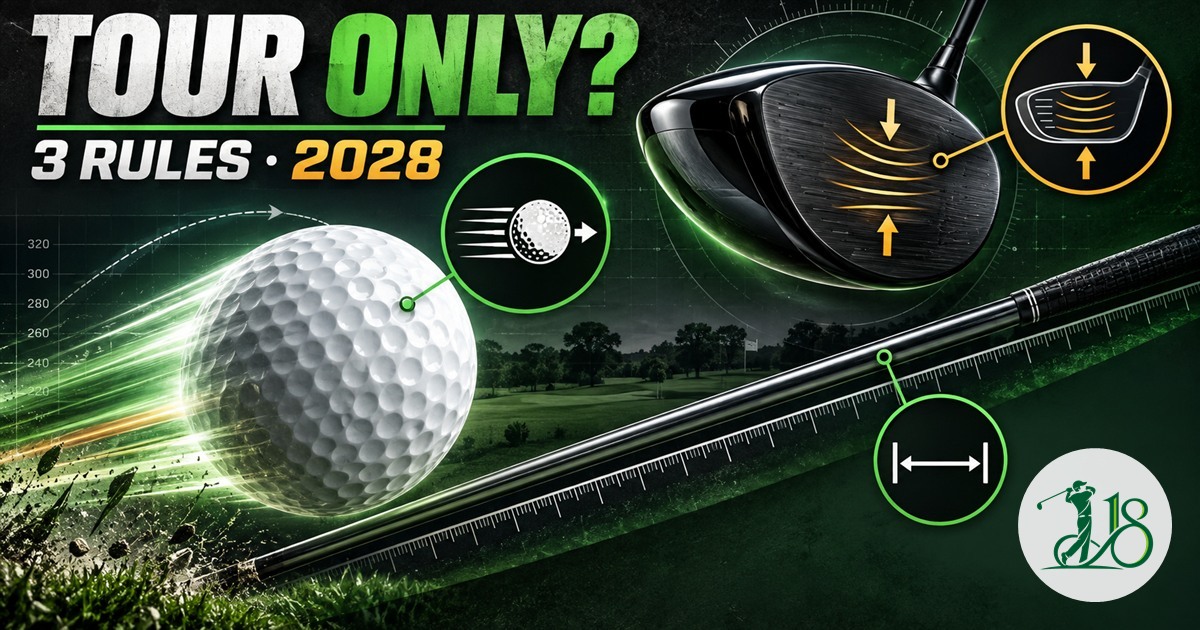
The next equipment argument in professional golf is not one rollback. It is three separate levers that tournament committees could choose to pull. In a September notice to manufacturers, the USGA and R&A described potential Model Local Rules affecting the ball, the spring effect of a driver face and the maximum length of a club other than a putter. The governing bodies said the PGA Tour and DP World Tour requested the work.
That distinction matters. A Model Local Rule is an optional condition a committee may adopt for a particular competition. It is not a universal change to the equipment rules. The proposals are aimed at elite events, the consultation remains open, and January 2028 is only the earliest possible start. A golfer shopping this fall does not suddenly need a new driver, shorter shaft or different ball.
The wider golf-ball rollback already scheduled for 2030 is a separate issue. The current notice explores what elite tours could do sooner, and whether a targeted tournament condition can address distance without immediately reaching every player.
The ball proposal removes the apparent three-yard cushion
The first option would use a 317-yard overall-distance standard for balls used under the local rule. The important detail is the absence of the apparent three-yard testing tolerance that has traditionally accompanied the published limit. In practical terms, the conforming target would become tighter for the elite ball selected under that competition condition.
This is not a simple promise that every drive will fly exactly three yards shorter. Laboratory conformance testing uses specified launch conditions; real outcomes still depend on speed, launch, spin, weather, turf and the player's strike. Manufacturers would have to design and submit products to meet the applicable test, while tours would decide whether to require one in their events.
For viewers, the central question is whether elite players would use a distinct tournament ball before the universal 2030 change. For everyday buyers, the practical answer is to wait. A ball currently legal under the Equipment Rules remains legal for ordinary play unless the rules governing that play change.
The driver proposal targets spring effect, not head size
The second option concerns characteristic time, or CT, the pendulum-based measurement used to assess the spring-like effect of a clubface. The reported proposal points to a 239-microsecond target without the present 18-microsecond testing tolerance. It does not shrink the familiar 460-cubic-centimeter driver head, outlaw modern materials or set one retail model for the field.
The likely pressure point is manufacturing and tour validation. Driver faces are built within tight tolerances, and heavily used faces can change. A stricter competition limit could push companies toward more margin below the ceiling, require careful tour-truck testing and make equipment checks more visible at elite events.
That still does not translate cleanly into a yardage number for every player. Ball speed is influenced by delivered loft, face contact, club speed and the ball itself. The rule would regulate a property of the club; it would not guarantee the same distance effect across a professional field.
The earlier elite-ball debate explains why governing bodies use a Model Local Rule when they want an option for top competitions without immediately changing recreational play. Video: Golf Channel on YouTube.
The length option would move below 46 inches
The third proposal would reduce the maximum club length available under the local rule from the current 46 inches. Putters would remain outside that measurement. The notice does not turn every standard driver into a nonconforming club; it asks what shorter ceiling should apply when an elite committee adopts the condition.
Many tour players already use drivers shorter than 46 inches because centered contact and control can be worth more than theoretical speed. The competitive effect would therefore depend on the final number and on which players presently rely on longer builds. Long-drive specialists and a smaller group of tour players could feel it more than the typical professional, while most recreational stock drivers are already below the current maximum.
Length is also the easiest proposal for consumers to misunderstand. Cutting a shaft changes swing weight, feel and sometimes flex behavior. There is no reason to trim a current club in anticipation of an optional elite rule, and doing so without a fitting can create a different problem rather than solve one.
Why three separate options are more consequential than one headline
Offering three levers gives tours flexibility. A committee might eventually adopt one, combine two or decide the competitive and operational costs are too high. Ball supply, player contracts, equipment testing, enforcement and coordination across tours all matter. A local rule also works best when major competitions and leading tours move together; fragmented adoption would ask players to switch setups between weeks.
The proposals also separate where distance comes from. The ball governs every full shot. Driver CT targets one club property. Maximum length addresses potential speed created through a longer lever. Their effects overlap, but their burdens do not. A ball condition reaches every player and manufacturer at once; a club rule may affect fewer builds but demand more event-site measurement.
Golf Digest and GOLF both report that the tour requests shaped this near-term approach. That makes the consultation more than a theoretical governing-body exercise, but it does not guarantee adoption. Manufacturer feedback is due October 21, after which the USGA and R&A must evaluate technical evidence and implementation concerns.
What golfers should do now
Keep playing the equipment you own. Do not buy a speculative “2028 conforming” product unless a manufacturer can identify an adopted standard and the competition in which it applies. No final elite local rule exists yet, and ordinary club golfers are not the target population.
If you compete at a high level, check the committee's conditions of competition rather than relying on social-media summaries. Model Local Rules apply only when adopted. A college, state amateur or professional qualifier could make a different choice from a weekly tour event, and the implementation date would matter as much as the technical limit.
For equipment companies, the next meaningful date is October 21. Their submissions should clarify whether the proposed tests can be administered consistently, how much redesign and inventory separation would be required, and whether the options produce an effect large enough to justify a separate elite standard.
For everyone else, the debate is worth following because it could establish genuine bifurcation: elite competitors using a condition that weekend golfers do not. But following is not the same as reacting. Until the consultation becomes an adopted rule, the correct consumer move is simple—fit equipment for the game you play now, not for a tour rule that may change before 2028.